Can You Tune a Violin with a Guitar Tuner?
Welcome, fellow music enthusiasts! I am thrilled to take you on a grand adventure into the enchanting realm of string instruments and the wondrous art of tuning. Today, we embark on a mesmerizing exploration of the captivating world of violin tuning. Whether you are an aspiring virtuoso or a seasoned maestro, mastering the delicate skill of tuning your beloved violin is absolutely essential for weaving breathtaking melodies.
As we venture forth in this guide, it becomes abundantly clear that precision and accuracy reign supreme when it comes to coaxing harmonious sounds from our dear instrument’s strings. While many musicians opt for specialized tools such as string instrument tuners or rely on proficient professionals to perfect their tuning, some may ponder over the possibility of using an alternative device like a trusty guitar tuner instead. In this illuminating piece, we shall delve deep into the intricate nuances surrounding harnessing a guitar tuner for violin tuning.
However, before taking the plunge into our main discourse regarding guitar tuners and their suitability for violins, let us first unravel the mystique that shrouds violin tuning itself. Additionally, we shall contemplate any noteworthy disparities between these two bewitching instruments – violins and guitars – that might influence your decision-making process when it comes to selecting your preferred tuner or method. Brace yourself as we embark upon this marvelous journey through all facets related to masterful violin tuning!
Understanding Violin Tuning
When it comes to tuning a violin, understanding the process is crucial for achieving accurate and beautiful sound. Violin tuning involves adjusting the tension of the strings to produce the correct pitches. In order to achieve this, it’s important to have a basic knowledge of the instrument and its strings.
The violin has four strings: G, D, A, and E. Each string corresponds to a specific pitch. The G string is the lowest and has the thickest gauge, while the E string is the highest and has the thinnest gauge. To maintain proper intonation and harmonious playing, all four strings must be tuned correctly.
Traditionally, violinists tune their instruments by ear using relative pitches as a reference point. However, with advancements in technology, many players now rely on electronic tuners to ensure accuracy. Electronic tuners are designed specifically for musical instruments like violins and guitars.
With an electronic tuner, you can simply attach it to your instrument or place it nearby while plucking each string. The tuner will visually indicate whether you need to tighten or loosen each string until it reaches the desired pitch. This method provides precise tuning accuracy even for beginners who may not have developed a trained ear yet.
In addition to electronic tuners, some violins are equipped with fine tuners on each string. These fine tuners allow for micro-adjustments to achieve perfect pitch without having to use pegs on the scroll of the instrument.
By using an electronic tuner or relying on fine tuners if available on your violin, you can easily tune your instrument with confidence and precision. This helps ensure that your instrument is always in tune during practice sessions and performances alike.
In summary:
- Violin tuning involves adjusting the tension of its four strings.
- Traditionally done by ear but modern tools like electronic tuners provide more accurate results.
- Fine tuners on certain violins aid in precise tuning.
- Using these tools, you can easily achieve proper pitch, resulting in beautiful melodies and harmonies.
Differences Between an Electric Guitar and Violin
When it comes to tuning a musical instrument, it’s important to grasp the distinctions between an electric guitar and a violin. Even though both instruments utilize strings, they possess unique qualities that differentiate them.
One of the key variations lies in the number of strings. Electric guitars typically boast six strings, whereas violins have four. Consequently, their tuning methods and techniques may differ from one another.
Furthermore, the presence of fine tuners sets these instruments apart. Violins are commonly equipped with fine tuners on each string, enabling more precise adjustments. In contrast, electric guitars rely on tuning pegs situated at the headstock for their tuning needs.
Another differentiating factor is found in the pitch range. Guitar strings are tuned to E-A-D-G-B-E from low to high, whereas violin strings are tuned to G-D-A-E from low to high.
Understanding these discrepancies will aid you in selecting the right tools and techniques when it comes to tuning your instrument. Whether you’re an amateur or a seasoned musician, comprehending how to tailor your tuning process specifically for your violin will guarantee optimal sound quality and an enjoyable playing experience.
Using a Guitar Tuner for Violin Tuning
https://www.youtube.com/watch?v=mC\_UVo1bPGY
To tune a violin using a guitar tuner, there are a few steps to follow. First, make sure that your guitar tuner can detect the range of pitches produced by a violin. This is important because some tuners are specifically designed for guitars and may not work effectively for violins.
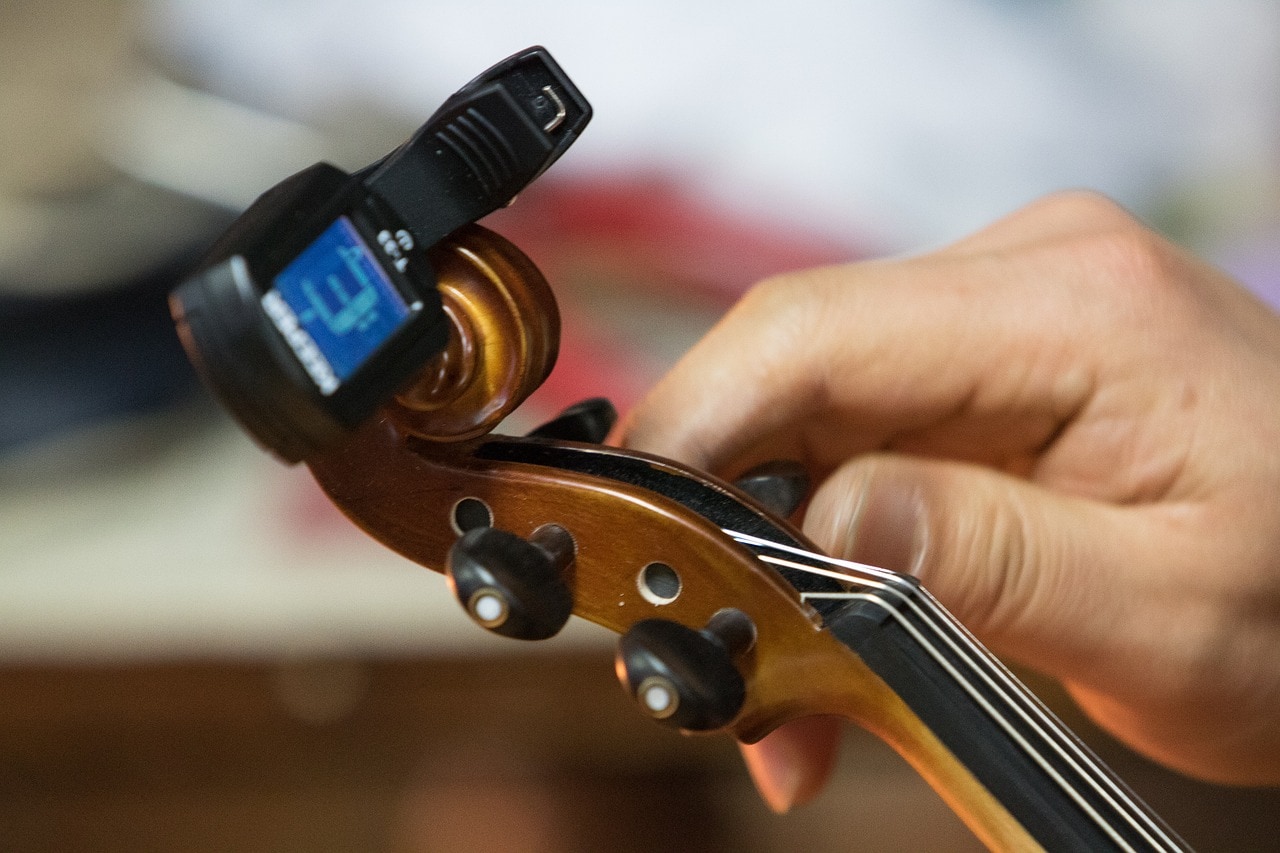
Next, place the tuner on the body of your violin or attach it to the scroll using a clip-on tuner. Placing it near the bridge will give you accurate readings.
Now, pluck each string one by one and observe the tuner display. It will show whether your string is flat (too low) or sharp (too high). Adjust the pegs accordingly until the tuner shows that you have reached the desired pitch.
Remember to take your time while tuning and use small adjustments on the pegs. It’s also helpful to have proper lighting so that you can see the tuner display clearly.
Using a guitar tuner for violin tuning can be an efficient method, especially if you already have one available. However, keep in mind that dedicated violin tuners or smartphone apps specifically designed for violins may provide more accuracy and additional features tailored to string instruments.
Alternative Methods for Tuning a Violin
Digital tuners are one of the alternative methods to tune your violin accurately. These small devices are designed specifically for string instruments and provide precise measurements of pitch. To use a digital tuner, simply attach it to the scroll or body of your violin and pluck each string individually. The tuner will show you the pitch in real-time, helping you adjust the tension of your strings accordingly. It’s important to make sure that you’re using a chromatic tuner, which can detect all pitches, rather than a guitar tuner that only recognizes specific notes.
Using Harmonics
Another alternative method for tuning your violin is by using harmonics. This technique involves lightly touching the string at specific points while bowing gently near those points to produce subtle tones called harmonics. By comparing these harmonics with the desired pitches, you can adjust the tuning pegs accordingly. However, this method requires some practice and ear training to develop accuracy.
Relative Tuning with Double Stops
If you don’t have access to a digital tuner or prefer a more intuitive approach, you can use relative tuning with double stops. Start by playing an open string as a reference pitch and then play another note on an adjacent string simultaneously (known as a double stop). Listen carefully for any dissonance or wavering between the two notes. Adjust the pegs until both notes sound in harmony.
Remember that alternative tuning methods may not be as accurate as using a dedicated digital tuner but can still be useful when traditional methods are unavailable or impractical.
Tips for Proper Violin Tuning
When it comes to tuning my violin, there are a few important tips I always keep in mind. Whether you’re a beginner like me or an experienced player, these tips will help us achieve accurate and consistent tuning every time.
- Using a tuner: One of the easiest ways to tune our violins is by using a handy string instrument tuner or a reliable chromatic tuner. These amazing devices are designed to detect the pitch of each string and conveniently display it on their screens. They make the whole tuning process so much simpler for someone like me.
- Tuning techniques: I usually start by gently plucking each string and adjusting the pegs accordingly until they match the desired pitch. It’s important to be patient and make small adjustments while checking the pitch frequently using our trusty tuner. We definitely don’t want to over-tighten or loosen any strings.
- Watch that tuner: As I tune my violin, I always have one eye on my convenient tuner display. It helps me stay in control and shows me whether I need to tighten or loosen each string in order to reach that perfect pitch.
- Don’t forget about those fine tuners: Luckily for us, our violins come equipped with four handy fine tuners located near the tailpiece. These little wonders allow for more precise adjustments without needing to constantly turn those pesky pegs. So let’s use them wisely once we’ve reached close to our desired pitch using the pegs.
I always remind myself that proper violin tuning is crucial for achieving optimal sound quality and creating a wonderful playing experience. By taking good care of our instruments through regular maintenance and careful tuning, we can ensure that our violins stay in tune longer and provide us with beautiful music-making opportunities! So let’s keep these tips in mind as we embark on our tuning adventures.
Common Mistakes to Avoid When Tuning a Violin
One of the most important aspects of tuning a violin is to avoid common mistakes that can lead to inaccurate tuning. Making these mistakes not only affects the sound quality but can also put unnecessary strain on the instrument.
- Relying solely on the tuner: While using a tuner is a great tool for initial tuning, it’s essential to train your ear as well. Depending solely on a tuner can hinder your ability to develop proper pitch recognition.
- Ignoring fine tuners: Violins have fine tuners located on the tailpiece, and it’s crucial to use them for small adjustments instead of relying solely on the pegs. This helps in achieving more precise tuning without putting excessive tension on the strings.
- Tuning with excessive force: Applying too much force when turning the pegs can cause damage or breakage of strings, pegs, or even the bridge. It’s important to apply gentle pressure while making adjustments.
- Not checking for string slippage: Strings may slip over time due to continuous playing or temperature changes. Before starting tuning, check if any strings have slipped and adjust accordingly.
- Skipping proper maintenance: Neglecting regular maintenance can affect the overall playability and sound quality of your violin. Always keep your instrument clean, periodically check for loose fittings or cracks, and change worn-out strings promptly.
By avoiding these common mistakes, you’ll be able to tune your violin accurately and maintain its longevity while preserving its beautiful tone.
Maintenance and Care for Your Violin
When it comes to taking care of my violin, there are a few important things to remember. First and foremost, I need to regularly clean my instrument in order to keep it in the best possible condition. After each use, I make sure to gently wipe down the body of the violin with a soft cloth. This helps remove any dirt or residue that may have accumulated during play.
I also pay close attention to the strings, checking for any signs of wear or damage. If I notice any issues, I promptly replace them to ensure optimal sound quality. Another important aspect of maintenance is inspecting the bow. I carefully examine it for loose hairs or cracks, as these can affect its performance. By addressing any concerns with my bow, I can ensure smooth and consistent playing.
In order to protect my violin from potential harm, I store it in a proper case. This case shields my instrument from extreme temperatures and humidity which can be detrimental to its overall health. By providing a safe and secure environment for my violin when not in use, I am helping prolong its lifespan.
Taking these steps not only ensures that my violin sounds its very best but also prevents any unnecessary damage or costly repairs. As someone who deeply appreciates their instrument, it is essential for me to prioritize maintenance and care in order to maintain its longevity and continue enjoying the beautiful music it produces.
Frequently Asked Questions
Conclusion
In conclusion, tuning a violin with a guitar tuner is indeed possible. By understanding the similarities and differences between these two instruments, musicians can successfully use a guitar tuner for violin tuning. However, it is important to note that using a dedicated musical instrument tuner specifically designed for string instruments like the violin and viola is highly recommended for accurate and precise tuning. These tuners provide instrument-specific pitch comparison and offer features such as fine tuners that cater to the nuances of string instruments. Additionally, adopting proper musical instrument care techniques and seeking professional guidance when needed will ensure that your violin stays in tune and performs at its best. So go ahead and confidently tune your violin using the right tools and techniques!
Can I use a guitar tuner to tune a violin?
Yes, it is possible to use a guitar tuner to tune a violin. However, there are some differences between the two instruments that need to be considered.
What are the differences between an electric guitar and a violin when it comes to tuning?
Electric guitars usually have a built-in electronic tuner, while violins require an external tuner. Additionally, the tuning pegs on a violin require more delicate adjustments compared to the tuning keys on a guitar.
How do I use a guitar tuner for violin tuning?
To use a guitar tuner for violin tuning, you need to connect the tuner to the violin’s bridge or body using a clip-on tuner or a microphone attachment. Follow the tuner’s instructions to tune each string of the violin to the desired pitch.
Are there alternative methods for tuning a violin?
Yes, there are alternative methods for tuning a violin. Some musicians prefer using tuning forks, pitch pipes, or even smartphone apps that have violin-specific tuning features.
What are some tips for proper violin tuning?
Some tips for proper violin tuning include: tuning the A string first, using small and gradual adjustments, checking the tuning multiple times, and making sure the violin is properly seated on your shoulder before tuning.
What are some common mistakes to avoid when tuning a violin?
Some common mistakes to avoid when tuning a violin include: using excessive force when turning the pegs, not checking the other strings when tuning, and forgetting to adjust the fine tuners after using the pegs.
How should I maintain and care for my violin?
To maintain and care for your violin, you should keep it in a protective case when not in use, wipe it down with a soft cloth after each playing session, avoid exposing it to extreme temperatures or humidity, and have it professionally serviced and restringed regularly.